AI App Development: A Founder's End-to-End Guide
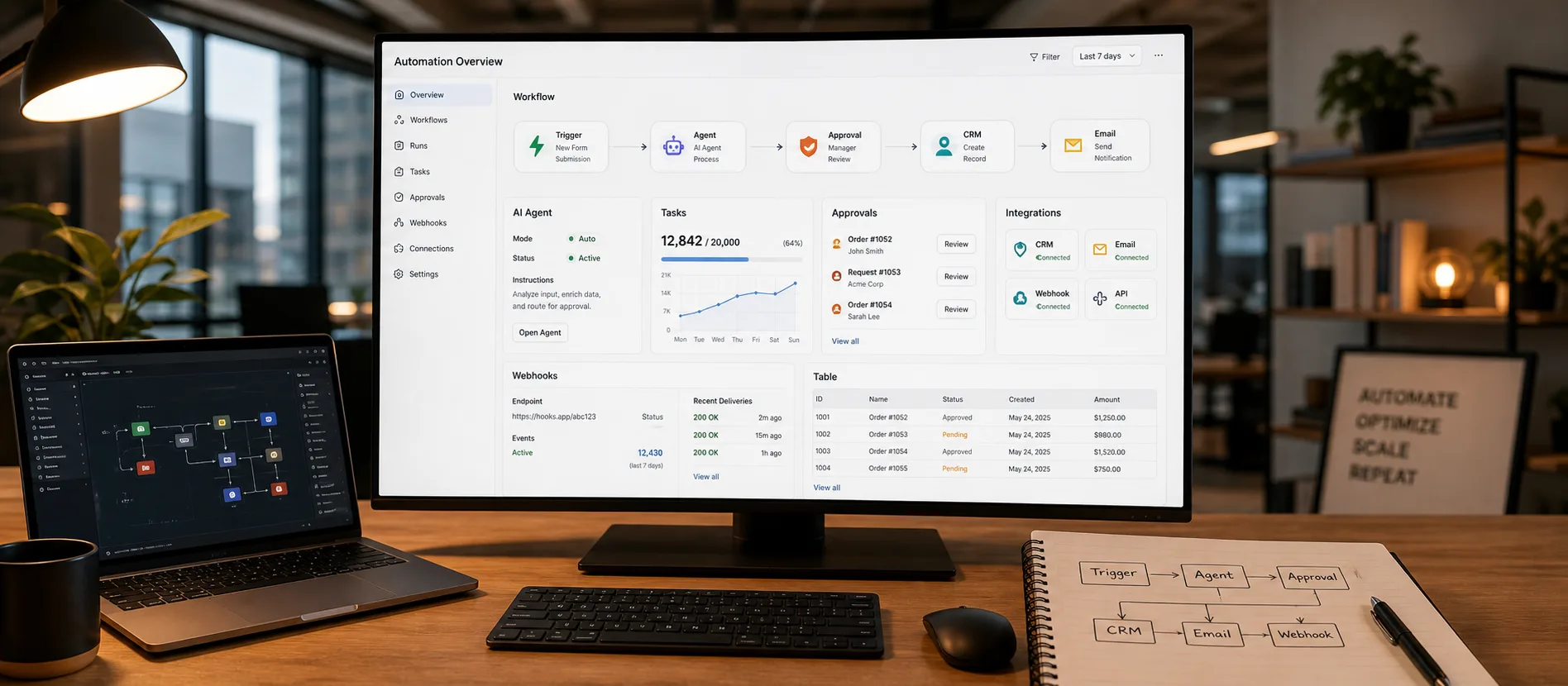
AI app development is the work of building a product where a machine learning model, usually a large language model, does part of the job a person or fixed code would otherwise do: answering, searching, deciding, seeing or speaking. The model is the smallest part of the build. Most of the effort goes into the backend that controls it, the data it is allowed to see, the tests that prove it works and the guardrails that keep it safe.
This guide walks a founder through the whole journey: which kind of AI app you are actually building, the reference architecture, how to build an AI app in phases, what drives AI app development cost, the privacy rules that apply in the US, Europe and the Gulf, and how to evaluate quality before customers do it for you.
Thinking about an AI agent or automation for your team? Message me on WhatsApp or see my AI agent development work.
The four kinds of AI apps
Founders often say "AI app" when they mean very different products. Naming the type early sets the budget, the timeline and the risk.
| Type | What it does | Typical example | Core components | Relative complexity |
|---|---|---|---|---|
| Assistant | Answers or writes in response to a user, one turn at a time | Writing helper, onboarding chatbot, support reply drafter | Model API, prompt design, streaming UI | Lowest |
| Knowledge app (RAG) | Answers from your own documents with citations | Policy search for staff, product manual Q&A, legal research tool | Document ingestion, embeddings, vector search, citation UI | Medium |
| Agent | Takes multi-step actions using tools, with or without approval | Booking changes, CRM updates, report generation, operations triage | Tool definitions, MCP servers, permissions, approvals, step limits | High |
| Vision or voice app | Understands images, documents, audio or speech | Receipt scanning, damage inspection, voice ordering, call summaries | Multimodal models, speech-to-text, text-to-speech, latency tuning | Medium to high |
Many real products combine types. A field service app might use vision to read a meter photo, RAG to find the right repair procedure and an agent to raise the work order. Build the simplest type first and add the next one once the first is measurably good.
When AI agent development is the right call
AI agent development is worth it when a task needs several steps, the steps depend on what the previous one returned, and the inputs are too messy for fixed rules. If you can draw the full flowchart in advance, you need an automation with a model call inside it, not an agent. For back-office processes, a workflow tool is often enough; I explain that route in my guide to agentic automation in n8n. When several agents need to cooperate, read my multi-agent orchestration guide before committing, because coordination adds cost and failure modes.
Reference architecture for an AI app
Almost every AI app I build follows the same six-layer shape, whether the client is a web dashboard or a mobile app.
[ Client: web or mobile ]
        |  user message, auth token
        v
[ Backend proxy: auth, rate limits, prompts, keys ]
        |                     |                    |
        v                     v                    v
[ Model provider ]   [ Vector DB / search ]   [ Tools via MCP or APIs ]
        \_____________________|____________________/
                              v
             [ Observability: traces, cost, evals ]
1. Client. A web app (often Next.js) or a mobile app that streams responses token by token, shows progress during tool calls and lets users stop, retry or give feedback. If your product is mobile, my article on AI agents in React Native apps covers streaming and state on the device.
2. Backend proxy. The most important layer and the one founders try to skip. It holds the model API keys, checks who the user is, enforces usage limits per plan, assembles prompts and decides which tools the user may trigger. API keys must never ship inside a web bundle or mobile binary, because anyone can extract them.
3. Model provider. Hosted APIs from OpenAI, Anthropic, Google or others, or open-weight models on your own infrastructure. Keep the provider behind your own interface so you can switch models per task, or move providers when pricing, quality or data residency changes.
4. Vector database or search. For knowledge apps, documents are split into chunks, converted to embeddings and stored for similarity search. PostgreSQL with pgvector is enough for most early products; a dedicated vector database makes sense at larger scale or with complex filtering. Hybrid search that combines keywords and vectors usually beats either alone.
5. Tools and MCP. Tools are the functions an agent can call: look up an order, create a ticket, check a calendar. The Model Context Protocol (MCP) gives you a standard way to expose those tools so different agents and clients can use them. Tool design is a security decision: read-only by default, narrow parameters, hard limits on anything financial.
6. Observability. Log every prompt, model response, tool call, latency and token count, linked to a user and a session. Without this you cannot debug a bad answer, explain a cost spike or prove what happened in a dispute.
How to build an AI app: phases and timeline
Here is the phase plan I use with founders. Durations assume one experienced full-stack developer, with a designer part time, and are typical rather than guaranteed.
| Phase | Typical duration | What you get |
|---|---|---|
| 1. Discovery and data audit | 1 to 2 weeks | Defined use case, success metric, data sources, compliance checklist |
| 2. Prototype | 1 to 3 weeks | Rough working version on real data, first evaluation set of 30 to 100 examples |
| 3. MVP build | 4 to 10 weeks | Production backend, auth, client UI, tools, logging, usage limits |
| 4. Evaluation and hardening | 2 to 4 weeks | Regression tests, prompt injection tests, cost controls, fallback paths |
| 5. Launch and iteration | Ongoing | Monitoring, feedback loop, model and prompt updates |
A simple assistant can reach production in six to eight weeks. A RAG knowledge app with messy source documents, or an agent that touches payments or customer records, more often takes three to five months. The biggest schedule risk is not the model; it is data that turns out to be scattered, outdated or legally off limits, which is why phase one exists.
Treat the prototype as disposable. Its job is to answer one question: can a model do this task well enough on your real data? If the answer is no after honest prompting and retrieval work, stop or change the scope before you spend on the MVP.
AI app development cost
AI app development cost has two parts that behave very differently: the one-time build and the ongoing running cost.
Build cost ranges
These ranges reflect typical independent and small-team rates across the US, UK, EU and Gulf markets. Agencies in high-cost cities can charge more; very small scopes can come in lower.
| App type | Typical build range (USD) | Main cost drivers |
|---|---|---|
| Assistant MVP | $10,000 to $35,000 | UI polish, auth, billing, number of languages |
| Knowledge app (RAG) | $25,000 to $70,000 | Document volume and formats, access permissions per user, citation quality |
| Agent with tools | $40,000 to $120,000+ | Number and risk of integrations, approval flows, audit requirements |
| Vision or voice app | $30,000 to $100,000+ | Real-time latency targets, device support, accuracy thresholds |
For context, $40,000 is roughly £30,000, €35,000 or AED 147,000 at recent exchange rates. Integrations and compliance move the number far more than which model you choose. A mobile client on both iOS and Android adds to any of these, and a Next.js development web client is usually the cheaper place to launch first.
Model and token costs explained
Most hosted models charge per token, a unit of text a little shorter than a word on average. You pay separately for input tokens (everything you send: system prompt, conversation history, retrieved documents, tool results) and output tokens (what the model writes), with output usually priced several times higher than input.
Three practical consequences:
- Context is the hidden cost. A RAG app that stuffs ten long document chunks into every request pays for them on every request. Better retrieval with fewer, more relevant chunks cuts cost and often improves answers.
- Agents multiply calls. One user request to an agent might trigger five or ten model calls as it plans, calls tools and checks results. Cap the steps.
- Model choice per step matters. Use small, cheap models for classification, routing and extraction, and reserve top-tier models for reasoning and writing that users see.
Prompt caching, batch processing for non-urgent jobs and per-plan usage limits are the main levers. Prices change frequently and differ widely between models, so calculate cost per active user from real logs during the prototype and price your plans from that number, not from a guess.
Privacy and compliance
AI apps process exactly the kind of free text where personal data hides. Plan compliance in phase one.
GDPR (EU and UK GDPR). You need a lawful basis for processing, a data processing agreement with your model provider, clear retention rules and a way to honour deletion requests, including data stored in vector databases and logs. Check whether your provider uses API data for training (major providers generally do not by default on business APIs, but confirm in the contract) and whether EU-region processing is available.
EU AI Act. The Act entered into force in 2024 and its obligations phase in over several years. At a high level, a few practices are banned outright, high-risk uses (for example in hiring, credit decisions, education or critical infrastructure) carry heavy obligations, and many ordinary products carry transparency duties such as telling users they are talking to an AI and labelling generated content. Most startup assistants and knowledge apps fall outside the high-risk category, but you should document why. Take legal advice if your use case touches a high-risk area.
Gulf data residency. Saudi Arabia and the UAE both have personal data protection laws, and government, healthcare and financial clients in the region frequently expect data to stay in-country. Hyperscalers now operate cloud regions in both countries, but not every model is available in every region, so check model availability before you promise residency to a customer.
United States. There is no single federal privacy law, but state laws such as California's apply, and sector rules like HIPAA apply to health data. Enterprise buyers will also send security questionnaires; good logging and access controls make those painless. The same habits I use in mobile app security practices, such as no secrets on the client and least privilege everywhere, apply directly to AI backends.
Evaluation and testing
AI apps rarely crash. They give confident, plausible, wrong answers. Ordinary unit tests catch your code bugs but not those failures, so you need an evaluation practice alongside them.
- Build an evaluation set early. Collect 50 to 200 real inputs with the outcome you expect. Include edge cases, angry users, other languages and questions the app should refuse.
- Score automatically where you can. Exact checks for structured outputs, citation checks for RAG (did the answer cite a document that actually supports it), and model-graded checks for tone or completeness, spot-checked by humans.
- Rerun on every change. Any change to a prompt, model, retrieval setting or tool is a release. Run the evaluation set before shipping it, and compare against the previous score.
- Test adversarially. Try prompt injection through uploaded documents, emails and web pages. Content the model reads is data, never instructions, and tools must enforce permissions in code rather than trusting the model.
- Close the loop in production. Add thumbs up and down, sample real conversations for review (with consent and privacy controls) and feed failures back into the evaluation set.
Teams that treat evaluation as a core feature ship model upgrades in days. Teams without it are afraid to touch their prompts.
Common mistakes founders make
- Starting with an agent when an assistant or RAG app would deliver the value.
- Calling the model directly from the browser or phone with an exposed key.
- Pricing plans before measuring cost per active user.
- Indexing every document without checking who is allowed to see each one.
- Shipping without logs, so the first bad answer cannot be explained.
FAQ
How much does AI app development cost?
A focused assistant MVP typically costs $10,000 to $35,000, a RAG knowledge app $25,000 to $70,000 and an agent with real integrations $40,000 to $120,000 or more. Model usage is a separate monthly cost that scales with active users and context size.
How long does it take to build an AI app?
A simple assistant can launch in six to eight weeks. Knowledge apps and agents that connect to business systems usually take three to five months including evaluation and hardening.
Do I need to train my own model?
Almost never at the start. Prompting, retrieval over your own data and good tool design solve most problems. Fine-tuning or custom models make sense later, for cost, latency or a narrow task where you have lots of labelled examples.
Is AI agent development different from building a chatbot?
Yes. A chatbot answers. An agent acts, by calling tools that read and change real systems. That brings permissions, approval steps, audit logs and step limits that a chatbot does not need.
Build your AI app with someone who ships it
I am Numan, an independent full-stack developer working across web, mobile and agentic AI. I build AI features into products, and I build the whole stack: Next.js and React Native clients, Node.js backends, RAG pipelines, MCP tools and the evaluation that keeps them honest. If you have an AI product idea, or a prototype that needs to become production software, explore my AI agent development services and tell me what you are building. I will tell you which type of AI app it really is, what it should cost and where the risks are.