React Native in 2026
Version 0.86, Fabric, TurboModules, JSI, Hermes V1, React 19, and mature New Architecture adoption.

Cross-platform mobile development
An honest, up-to-date comparison of React Native and Flutter in 2026 performance, developer experience, and when to choose each. By Numan, full-stack React Native engineer.
Version 0.86, Fabric, TurboModules, JSI, Hermes V1, React 19, and mature New Architecture adoption.
Version 3.44, Dart, Impeller, a self-rendered widget system, and strong mobile plus multi-device tooling.
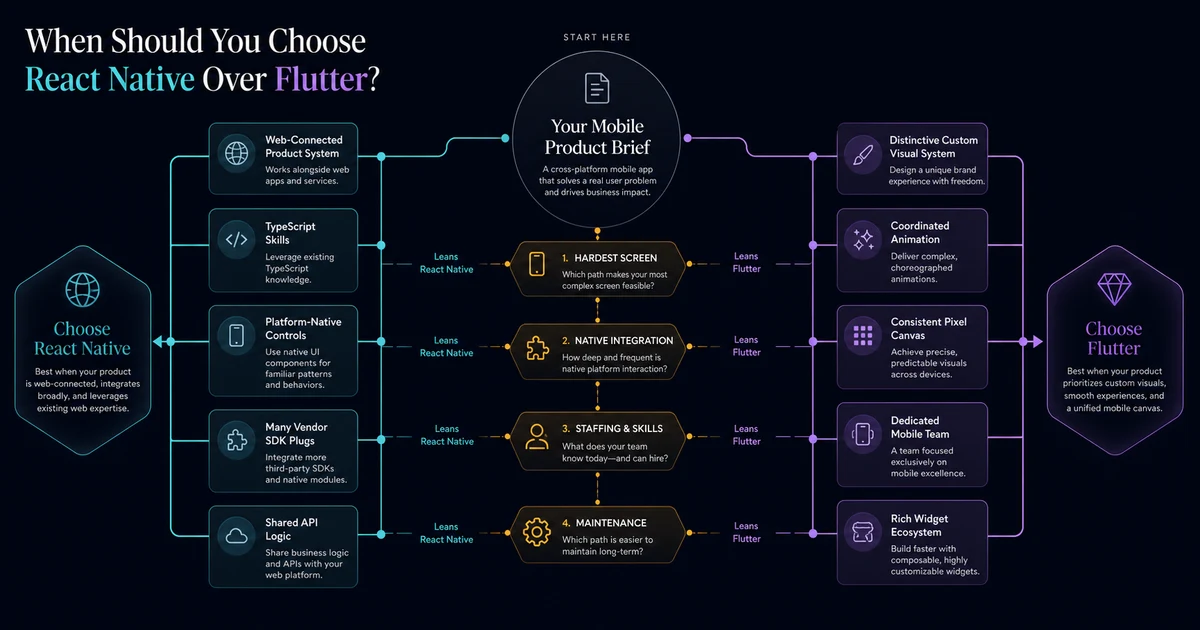
Prototype the hardest screen and native integration with the team that will maintain the app.
Both frameworks are mature enough for serious production work. React Native is no longer accurately described as a JavaScript bridge wrapping native views: its New Architecture uses Fabric, TurboModules, JSI, and a modern event loop, while Hermes V1 is the default JavaScript engine. Flutter still owns its widget and rendering pipeline, compiling Dart ahead of time for release builds and using Impeller to make frame rendering more predictable.
As of July 20, 2026, React Native 0.86 is the active stable line; its release notes describe it as the second recent release with no user-facing breaking changes. Flutter's official documentation reflects stable 3.44, released in May 2026. Those version numbers matter because comparisons built around React Native's legacy bridge or Flutter's pre-Impeller renderer are now historical.
There is no single official 2026 “market share” percentage that cleanly measures production mobile apps. Survey responses, repository stars, package downloads, and app-detection datasets measure different things, so I would not combine them into a winner statistic.
React Native renders platform components and coordinates them through Fabric. TurboModules and Codegen create typed boundaries for native capabilities, while JSI reduces the serialization and scheduling costs associated with the old asynchronous bridge. Since React Native 0.76 the New Architecture has been enabled by default, and current releases continue removing legacy architecture code. This is production infrastructure, not an experimental checkbox.
Flutter takes a different route. Its widget tree, layout, painting, and compositing model are controlled by Flutter rather than mapped primarily onto each platform's standard UI component set. Impeller precompiles shaders and pipeline state to reduce runtime shader compilation. Flutter documents Impeller as the only supported renderer on iOS and the default on Android API 29+, with fallbacks for older or unsupported Android devices.
The architectural tradeoff is control versus platform affinity. Flutter can deliver extremely consistent custom visuals because it owns more of the pixels. React Native feels closer to the surrounding React and native ecosystems and lets teams integrate native SDKs through modern typed modules. Neither architecture removes the need to understand Xcode, Gradle, Android lifecycle behavior, iOS permissions, accessibility, and store releases.
| Factor | React Native | Flutter |
|---|---|---|
| Language | JavaScript / TypeScript | Dart |
| Performance in 2026 | Strong for production product UI; Fabric and Hermes V1 reduce old architecture overhead | Strong, especially for custom drawing and animation through Impeller |
| Hot reload | Yes; Fast Refresh | Yes; stateful hot reload |
| Native module access | Strong through TurboModules, Codegen, JSI, Swift, Kotlin, Objective-C, and C++ | Strong through plugins, platform channels, FFI, Swift, and Kotlin |
| Talent pool size | Larger adjacent JavaScript, TypeScript, and React ecosystem | Smaller but established Dart and Flutter ecosystem |
| Best for | Teams with a JS/web background, native SDK needs, or code sharing with web | Pixel-controlled custom UI and teams focused on one Flutter codebase across targets |
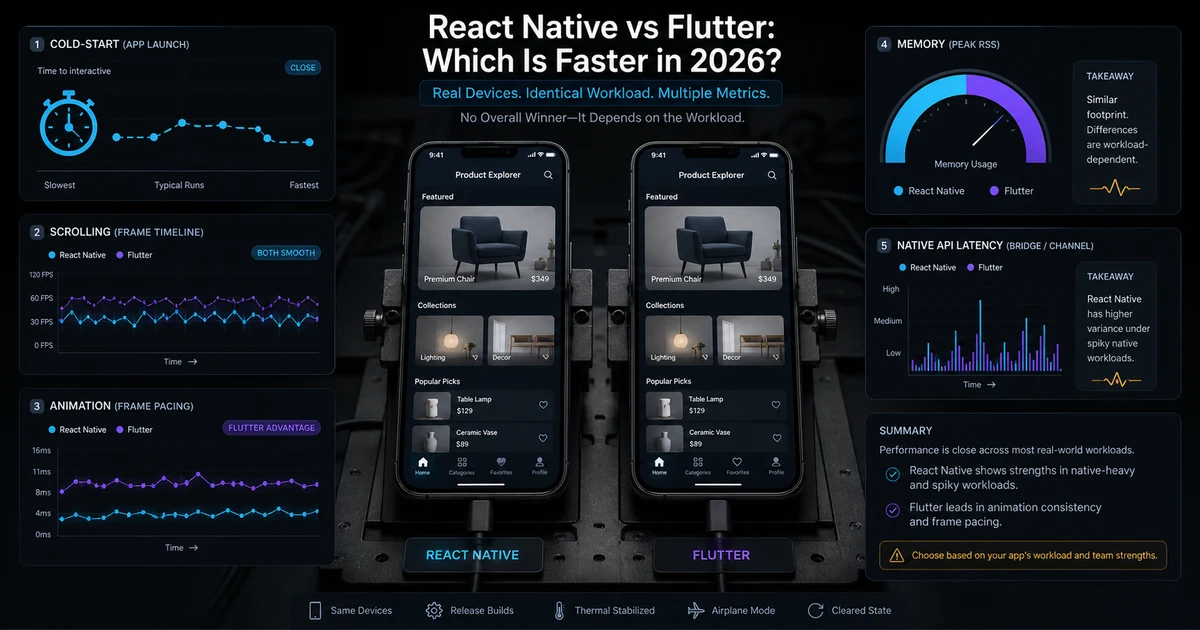
For a normal authenticated product—navigation, forms, feeds, media, maps, payments, and API data—either framework can feel fast. Users notice dropped frames, slow startup, touch latency, image decode stalls, and excessive network work; they do not notice the language on the source file. A well-profiled React Native app can outperform a poorly structured Flutter app, and the reverse is equally true.
Flutter has a genuine structural advantage for dense custom painting and coordinated animation because its engine owns the rendering pipeline. React Native can reach smooth results with Fabric, native components, optimized lists, and UI-thread animation systems such as React Native Reanimated, but heavy JS-thread work, broad state updates, or unbounded list rendering still creates visible problems.
One published 2026 comparison using release builds reported Flutter cold-start measurements of 480 ms on an iPhone 15 and 530 ms on a Pixel 7, versus 540 ms and 620 ms for React Native with Hermes and the New Architecture. Its long-list and complex-animation cases also favored Flutter on mid-range Android, while the differences narrowed on flagship hardware. Source: Bradata's 2026 device comparison.
Those numbers are evidence from one test suite, not a framework law. The article does not substitute for benchmarking your navigation stack, images, fonts, maps, analytics SDKs, and backend payloads on the slowest supported physical device. Flutter's own guidance similarly says performance work should use profile mode on physical iOS or Android hardware because debug builds and simulators are not representative.
In my React Native work, I profile startup work, React commits, JS and UI thread pressure, list virtualization, image memory, and native SDK calls before blaming the framework. The same discipline is covered in React Native performance optimization.
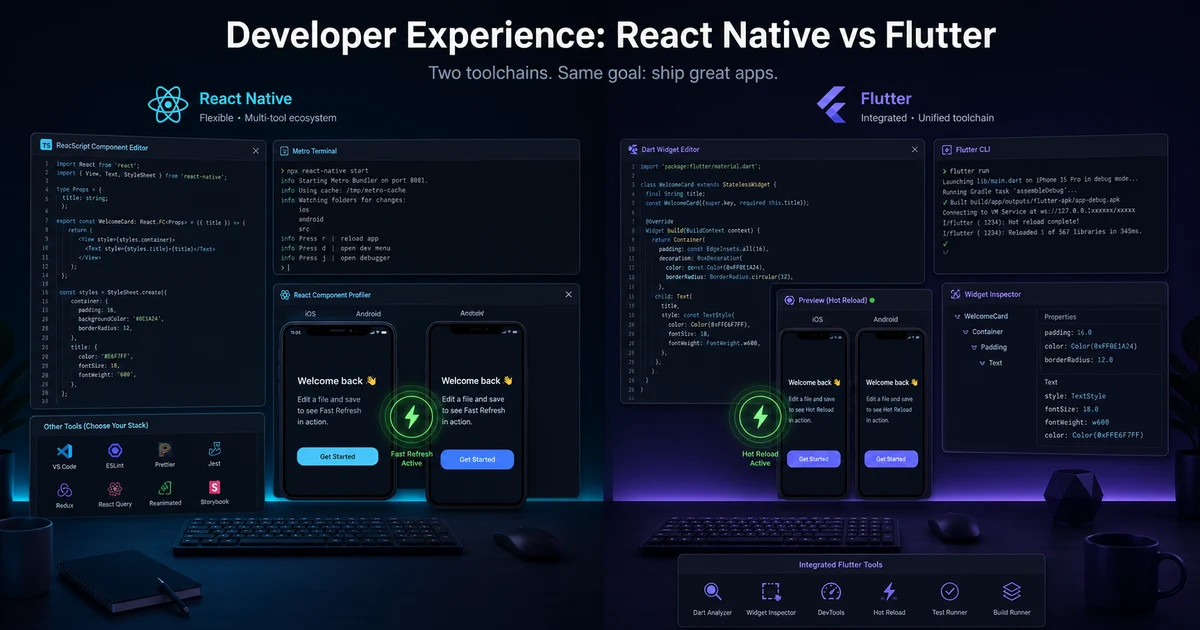
React Native is easier to enter for developers who already know React, TypeScript, npm, async JavaScript, and component-driven product development. Expo can simplify setup, builds, updates, and common native capabilities. The cost is ecosystem variability: Metro, Gradle, CocoaPods, Xcode, Android Studio, Expo modules, community packages, and native code can all intersect in one debugging session.
Flutter offers a more vertically integrated experience. Dart, the Flutter CLI, widgets, rendering, test tooling, DevTools, and package conventions feel like one system. Its stateful hot reload remains excellent for UI iteration. The learning curve is not only Dart syntax; developers must internalize constraints, widget composition, build context, rendering phases, isolates, and the difference between Material/Cupertino abstractions and real platform behavior.
Both have hot reload, useful profilers, mature IDE support, and large package ecosystems. React Native usually has broader access to JavaScript libraries, but a web-oriented npm package is not automatically mobile-safe. Flutter's pub.dev is more framework-specific, yet a plugin can still lag a new iOS or Android API. Before choosing, audit the exact camera, maps, payments, authentication, analytics, Bluetooth, background execution, and accessibility dependencies your product needs.
A qualified React Native app development company should still validate package compatibility and native requirements before promising one-codebase speed. Teams needing an experienced individual can also hire a React Native developer for architecture, delivery, and release ownership.
Flutter is not a consolation choice. For a branded consumer experience with extensive custom drawing, one focused Flutter team can be the clearer engineering decision. The broader cross-platform mobile app development question should include product design, native dependencies, release operations, and ownership—not only language preference.
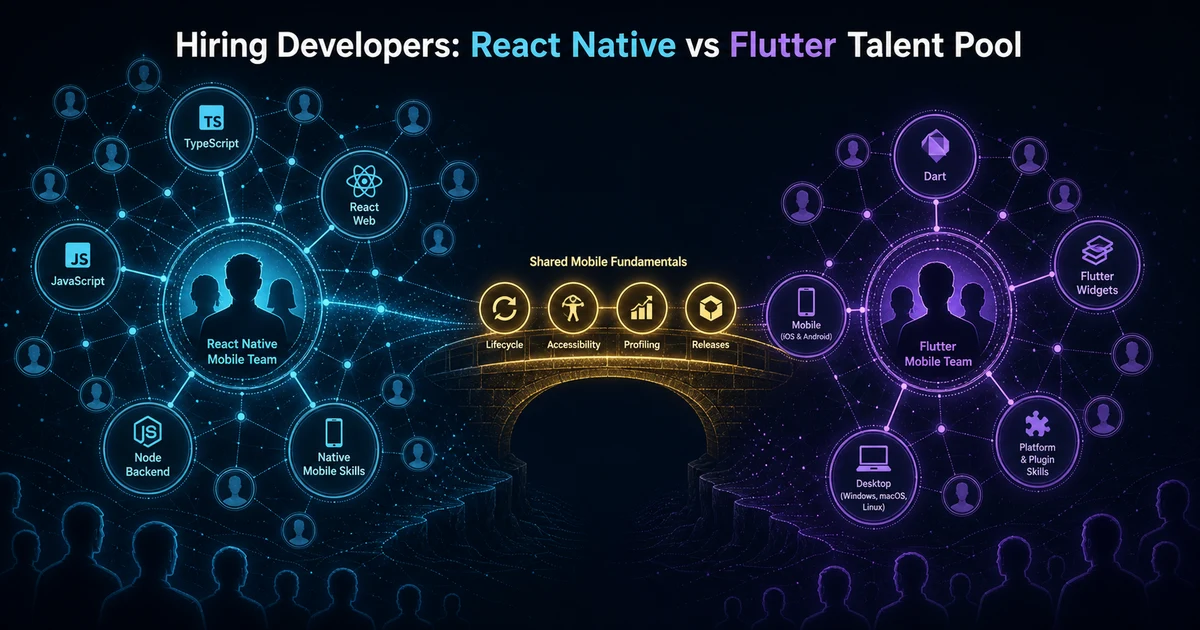
React Native benefits from the much larger adjacent JavaScript, TypeScript, and React community. That makes sourcing easier, especially when engineers can contribute to a Next.js surface or Node.js backend. It does not mean every React web developer is ready for mobile: app lifecycle, offline behavior, touch interaction, accessibility, native build systems, performance profiling, signing, and store releases remain specialist skills.
Flutter's Dart pool is smaller, but the signal can be more specific because applicants usually opted into mobile or Flutter work deliberately. Strong Flutter engineers often know the widget and rendering model deeply. The risk for either framework is hiring only for syntax. Ask candidates to diagnose a slow list, a failed iOS archive, Android process death, a deep-link race, and an inaccessible custom control.
For teams that already have an app and need an independent technical review, my React Native consulting services focus on architecture, performance, native integration, upgrades, and release risk rather than simply adding more screens.
React Native's official showcase lists Meta products including Facebook, Instagram, and Ads Manager; Microsoft Teams and Xbox Game Pass; and Amazon Shopping, Alexa, and Photos. Flutter's official showcase lists Google products and companies including SoFi, Toyota, talabat, KQED, Zoho, Nubank, Philips Hue, and Square.
Read those examples carefully. A company may use a framework for one app, selected surfaces, a gradual migration, or a particular platform—not necessarily its entire mobile estate. The useful conclusion is that both frameworks operate at serious scale. It is not proof that the same architecture, team shape, or framework is right for your product.
Treat a migration as a product rewrite with reusable contracts, not a source-code translation. Design tokens, backend APIs, analytics names, content, product rules, test scenarios, and native SDK decisions can transfer. React components do not become Flutter widgets automatically, and Flutter widgets do not become React Native components. Navigation, state bindings, accessibility semantics, build pipelines, plugins, and test harnesses need deliberate replacement.
A migration is justified when it changes the organization's long-term delivery economics, not because one demo animation or synthetic benchmark looked better.
I am a full-stack developer and agent-loop engineer based in Lahore, Pakistan, working remotely for global teams. I build with React Native, Next.js, Node.js, TypeScript, native Android and iOS. My bias is informed by shipping React Native systems, but the recommendation is still conditional: I would rather see a strong Flutter team own the right Flutter product than force React Native into every brief.
I have 25k+ reputation on Stack Overflow, maintain react-native-compressor with 200k+ weekly downloads and react-native-keys, and have contributed to React Native Core, Expo Core, and React Native Reanimated. That work exposes the less glamorous framework questions: binary compatibility, native threading, image memory, build tooling, platform differences, and library maintenance.
I currently work as Sr. Full Stack Mobile Engineer at Ninja, a Saudi Arabian grocery and food-delivery unicorn valued at $1B. You can see related production work and open-source context on numan.dev. My default recommendation is React Native when the surrounding team and product architecture make its React, TypeScript, native, and web connections valuable; Flutter wins when rendering control and a dedicated Dart team are the stronger constraints.
Neither is universally better. React Native usually fits teams already strong in TypeScript, React, and native platform integration. Flutter is excellent when a product needs a highly controlled visual system across targets. Choose after prototyping your hardest screen, native dependency, startup path, and hiring plan—not from a generic benchmark table.
Flutter often has an edge for dense custom drawing and animation because it controls rendering through Impeller. Modern React Native is competitive for typical product interfaces, lists, navigation, and native controls when code is profiled carefully. Real results depend more on startup work, image handling, list virtualization, state updates, and device testing than framework branding.
React Native generally has the larger adjacent talent pool because JavaScript, TypeScript, and React skills transfer from web development. Flutter's Dart pool is smaller but established, and experienced Flutter specialists can be very productive. Hiring quality still depends on mobile fundamentals: lifecycle, accessibility, networking, releases, profiling, and native debugging—not language familiarity alone.
Yes, but it is normally a rewrite of the presentation layer rather than a mechanical conversion. APIs, backend contracts, analytics plans, design tokens, and test cases can transfer. Widgets, navigation, state bindings, plugins, and native integration layers usually cannot. Migrate feature by feature only when both runtimes can coexist safely and the business case is clear.
React Native's official showcase includes Meta products, Microsoft Teams, Xbox Game Pass, Amazon Shopping, Alexa, and Amazon Photos. Flutter's showcase includes Google products, SoFi, Toyota, talabat, Nubank, Philips Hue, and Zoho. Company names prove production viability, but not that every screen or platform in each product uses one framework.
A startup with React or TypeScript capability, a related web product, or many native SDK requirements will often move faster with React Native. Flutter can be better when a small dedicated mobile team owns a distinctive visual experience across platforms. Prototype the riskiest integration and screen, then compare delivery speed, staffing, and maintenance—not demos alone.
Written by Numan — full-stack developer and React Native engineer based in Lahore, Pakistan. Currently Sr. Full Stack Mobile Engineer at Ninja, and author of react-native-compressor (200k+ weekly downloads). Connect on LinkedIn or GitHub.