Observed rate anchors
Upwork lists React Native developers at $24-$45/hour; Clutch reports $25-$49/hour for app development companies.
React Native app development costs
A realistic, up-to-date breakdown of React Native app development costs in 2026 by app complexity, team type, and hidden costs. By Numan, full-stack React Native engineer.
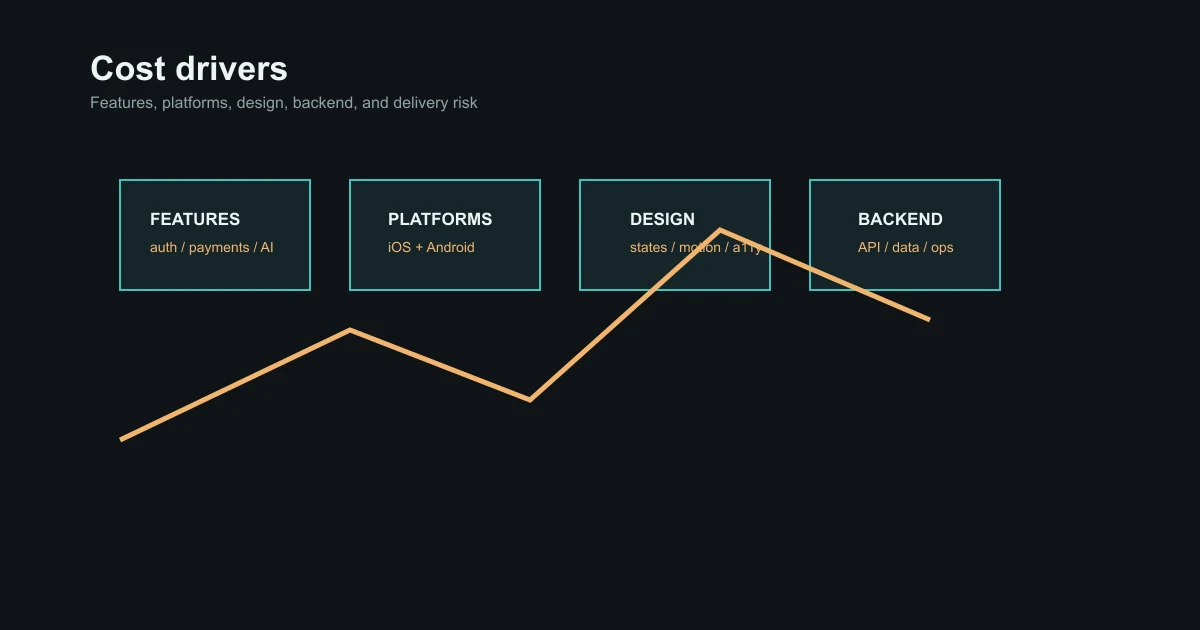
Upwork lists React Native developers at $24-$45/hour; Clutch reports $25-$49/hour for app development companies.
Price the riskiest workflows, backend, QA, and releases instead of counting screens alone.
React Native can cover iOS and Android from one codebase, but native integrations still need specialist work.
The honest answer is a range. In the current market, Upwork's React Native rate guide shows $24-$45 per hour for typical worldwide contracts. Clutch's July 2026 mobile app pricing guide reports $25-$49 per hour for app development companies and says most reviewed projects fall between $10,000 and $49,999. Those are rate and project observations, not a guarantee that your app fits either number.
For planning, I model a focused MVP at $8,000-$25,000, a mid-level product at $25,000-$75,000, and a complex or enterprise build at $75,000-$200,000+. These bands combine the published rate anchors with realistic hours for discovery, design, implementation, backend, testing, release, and contingency. A quote below them may be valid for a narrow prototype, a single platform, or incomplete delivery; it should not be compared with a production-ready scope without checking the exclusions.
React Native reduces duplicated UI work across iOS and Android, but it does not eliminate product design, API engineering, native SDK integration, QA, store review, or ongoing ownership. The relevant comparison is the total delivery system. My numan.dev work is intentionally full-stack because a mobile estimate that ignores the backend is usually not an estimate of the product.
Feature count is a weak shortcut. Two apps with ten screens can have completely different budgets if one is mostly static content and the other handles money, realtime state, sensitive data, or background work. I price the workflows and failure states behind the screens.
A focused React Native app development company or senior engineer should turn these variables into an assumptions list before giving a fixed price. That list is more useful than a low headline number.
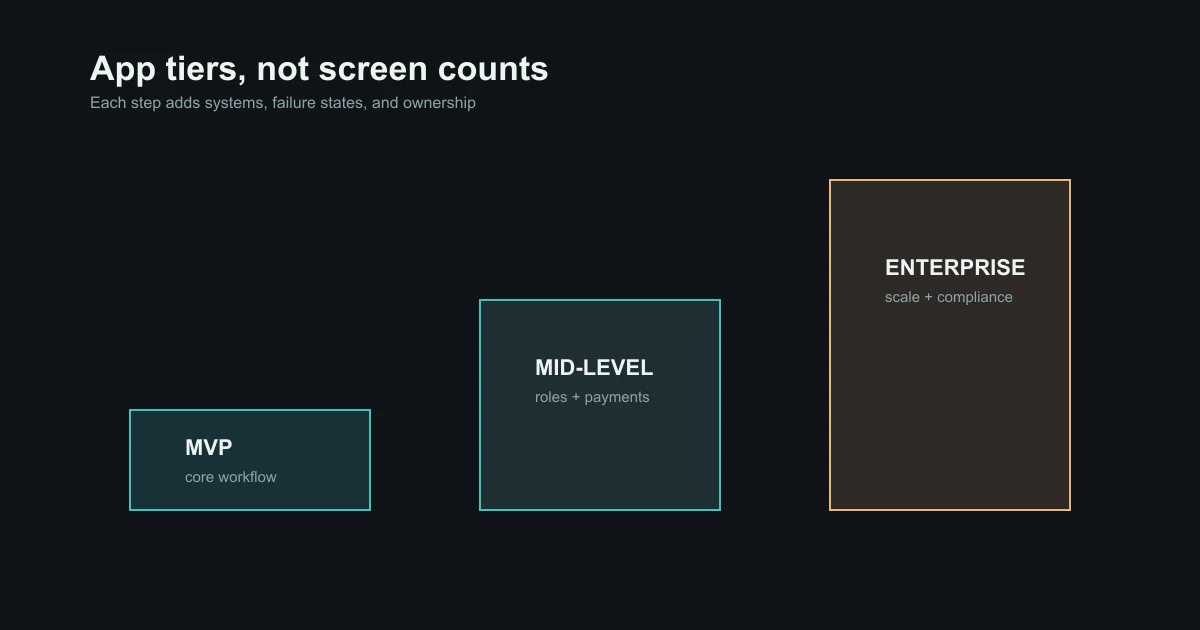
The table below is a practical planning model built from the published hourly anchors and the amount of product work each tier normally contains. It is deliberately broad: a heavily regulated MVP can cost more than a feature-rich consumer app with an existing backend.
| App Tier | Features | Typical Cost Range | Typical Timeline |
|---|---|---|---|
| MVP / Simple | Core auth, a small workflow, basic API, simple design system, analytics, and one or two integrations | $8,000-$25,000 | 8-16 weeks |
| Mid-Level | Multiple roles, payments, richer backend, push notifications, media, moderate offline or realtime behavior, QA, and both stores | $25,000-$75,000 | 4-7 months |
| Enterprise | Complex domains, advanced permissions, high availability, AI or realtime systems, compliance, admin tooling, observability, and a release team | $75,000-$200,000+ | 6-12+ months |
These are build budgets, not lifetime product budgets. Confirm whether discovery, UX research, backend, QA automation, app-store submission, source-code handover, and a warranty period are included. A React Native app can be a sensible form of cross-platform mobile app development, but shared code is only one line item in the delivery plan.
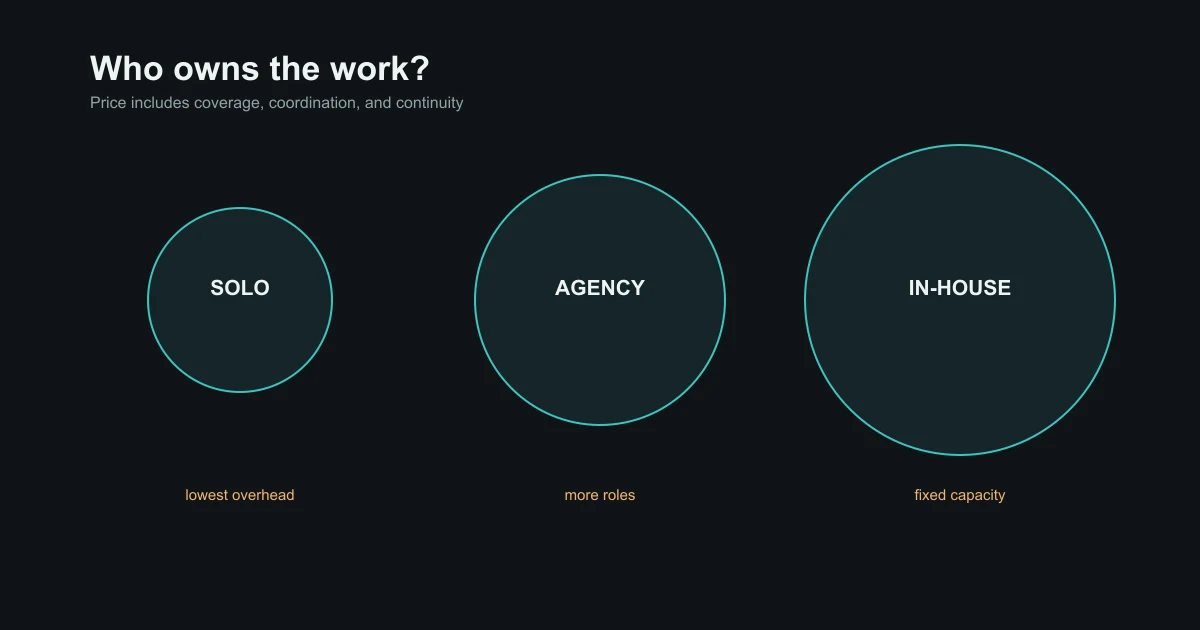
Team model changes both the hourly rate and what is included around the code. A freelancer may be the most efficient option when the product has a clear owner and a narrow MVP. A small agency adds delivery coverage, design, QA, and project coordination, but those roles appear in the price. An in-house team has the highest fixed commitment but compounds product knowledge over time.
| Model | Where it fits | Cost pattern | Main risk |
|---|---|---|---|
| Solo full-stack developer | Focused MVP, existing designs or backend, direct founder collaboration | Lowest overhead; often close to the $24-$45/hour freelance anchor | Single-person capacity, QA, design, and continuity |
| Small agency | Product needing design, mobile, backend, QA, and release coverage | Higher blended price; Clutch reports $25-$49/hour for many app companies | Coordination, handoffs, and paying for roles the scope may not need |
| In-house team | Ongoing roadmap, domain knowledge, support, and multiple products | Salary, benefits, recruiting, management, tools, devices, and idle capacity | High fixed cost before product-market fit |
For a small product, I often recommend a senior individual who can own mobile, API boundaries, release work, and technical decisions, then add specialist help where needed. Teams that need an independent architecture or delivery review can use my React Native consulting services before committing to a larger build.
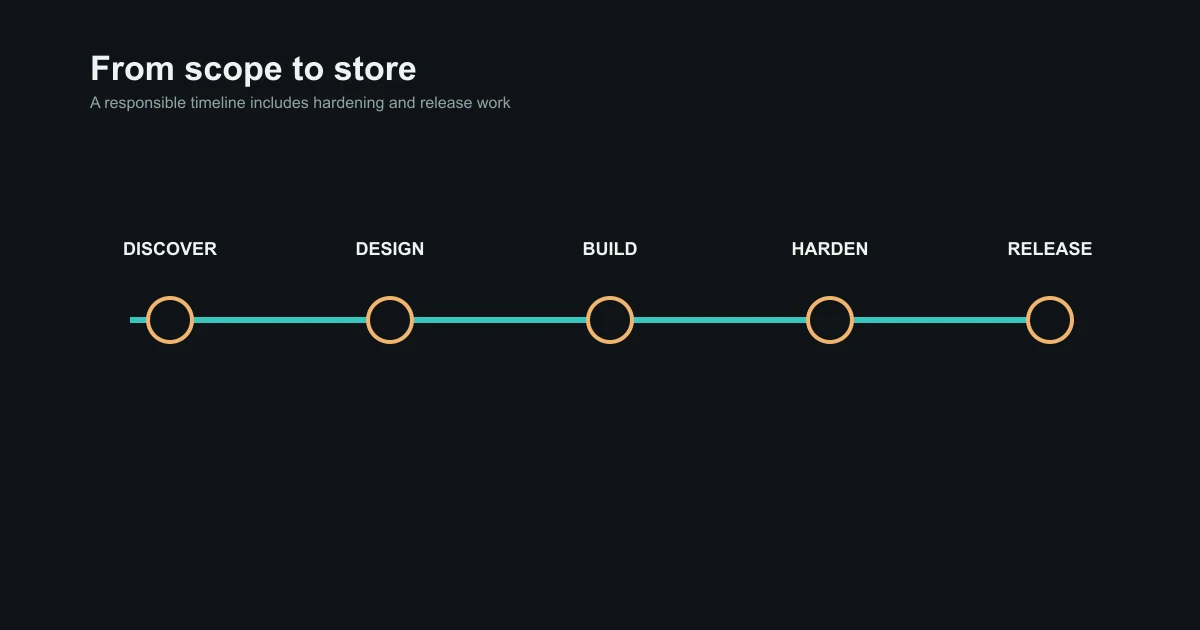
Calendar time follows scope, decision speed, and team capacity. A simple MVP can reach a store-ready beta in 8-16 weeks when the product owner can make decisions quickly and the backend is modest. A mid-level app usually needs 4-7 months for design, implementation, integration, device testing, bug fixing, and both-store release. Enterprise work commonly runs 6-12 months or longer because dependencies, compliance, migrations, and multiple environments add coordination.
Adding developers does not reduce the timeline linearly. More people help when work can be split cleanly, but they also add reviews, architecture decisions, environment setup, and communication. The fastest responsible path is usually to identify the riskiest workflow early: payment approval, background location, offline conflict resolution, realtime tracking, AI tool execution, or a difficult native SDK.
Budget a release hardening period. A demo can be complete while crash reporting, accessibility, slow-device performance, deep links, interrupted network requests, signing, store metadata, and privacy declarations are still unfinished. That final work is part of the app, not a postscript.
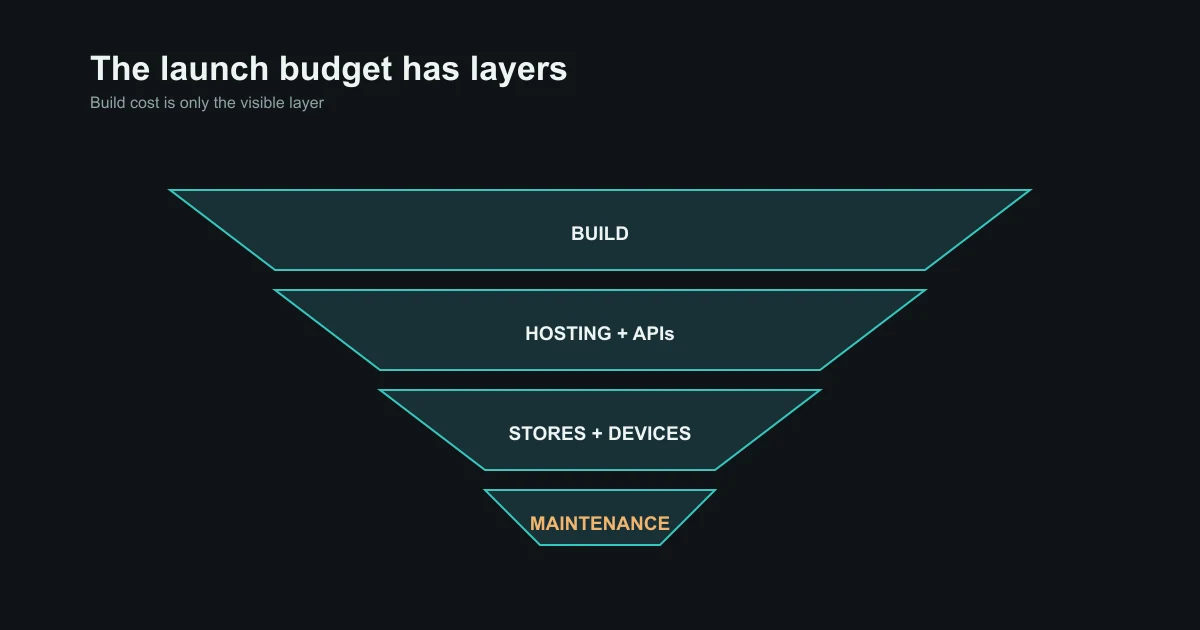
Do not hide these costs in a vague “miscellaneous” line. Put a monthly operating estimate and a yearly maintenance assumption next to the build quote so stakeholders can compare the real cost of ownership.
It can reduce delivery cost because labor and operating overhead are lower than in many North American, Western European, or Australian markets. Clutch's 2026 location table lists India below $25 per hour for many app companies and shows that companies commonly consider India, the Philippines, and other regions for offshoring. Pakistan is not a guarantee of a specific rate, and a senior engineer with production ownership should not be compared with the cheapest listing.
The quality test is process and evidence: inspect shipped apps, ask how the candidate handles a failed iOS archive or Android lifecycle bug, require a written scope and acceptance criteria, keep source and store accounts in the client's ownership, use pull requests and automated checks, and test on real devices. Time-zone overlap, clear English, weekly demos, documentation, and a staging environment matter more than a country label.
As a full-stack React Native engineer based in Lahore, I work directly with product teams rather than inserting a large chain of account management between the person building the app and the person making product decisions. Teams can hire a React Native developer for focused delivery, architecture, native integration, and release support. For a framework decision, my React Native vs Flutter in 2026 comparison covers the technical tradeoffs that also affect long-term cost.
A simple React Native MVP commonly budgets around $8,000-$25,000, a mid-level product around $25,000-$75,000, and a complex or enterprise app from $75,000 to $200,000 or more. These are scope-based planning ranges, not a universal price list; backend depth, design, integrations, QA, and team rates move the total.
The biggest drivers are feature risk and the number of workflows, not the React Native license or framework itself. Authentication, payments, realtime sync, AI, offline behavior, maps, media, permissions, custom design, iOS and Android release work, backend APIs, admin tools, testing, and compliance can each add substantial engineering time.
A capable freelancer or solo full-stack developer usually has lower overhead, so they can be cheaper for a focused MVP. An agency costs more for coordination, design, QA, and delivery coverage, but can reduce single-person risk on a larger build. Compare the actual team, hours, deliverables, and maintenance terms rather than labels.
A focused MVP often takes 8-16 weeks, a mid-level app roughly 4-7 months, and an enterprise product 6-12 months or longer. Timeline affects cost through engineering hours, not calendar weeks alone. A larger team may shorten the schedule, but it adds coordination and can increase total spend if requirements are still changing.
Budget for Apple and Google developer accounts, design and copy revisions, backend hosting, databases, storage, monitoring, email or SMS, maps, payment processing, AI and other third-party API usage, test devices, security work, store compliance, analytics, support, and post-launch maintenance. Revenue commissions and taxes are separate from the build quote.
Yes, when outsourcing changes the rate without removing engineering discipline. Pakistan and South Asia can offer lower delivery overhead, but quality still requires a written scope, direct technical communication, code review, tests, staging, documentation, ownership of accounts, and a real release process. Evaluate shipped apps and debugging ability, not geography or a low hourly quote alone.
Written by Numan, a full-stack developer and React Native engineer based in Lahore, Pakistan. I price mobile work around product risk, backend ownership, release quality, and the maintenance path rather than screen count alone. See more work on numan.dev.